

18 Jun Public Schools in Sydney’s Eastern Suburbs
Public schools in Sydney’s Eastern Suburbs are among the most highly regarded in NSW, attracting families with their strong academic results, established communities and diverse co-curricular opportunities. Funded and operated by the NSW Government, public schools provide free education from Kindergarten through to Year 12, following the NSW Department of Education curriculum.
The Eastern Suburbs are particularly well serviced by public primary schools, with highly regarded options in suburbs such as Bondi, Coogee, Randwick and Rose Bay. There are fewer public high schools across the region, though the area is home to two of the state’s most sought-after selective schools, and the 2025 merger of Randwick Boys and Girls High Schools into the new co-educational Randwick High School has expanded co-ed options for local families. Proximity to beaches, parks, transport and lifestyle amenities continues to make the area especially popular with families seeking both educational and lifestyle opportunities.
NSW public high schools fall into two categories: selective and comprehensive. Selective schools admit students through a competitive entrance process, with places awarded on academic merit regardless of where a student lives — Sydney Boys High and Sydney Girls High are the region’s selective schools, and among the most competitive in NSW. Rose Bay Secondary College also offers a selective stream alongside its local comprehensive intake. Comprehensive schools admit students within their local catchment zone, with no academic testing required for entry. Many comprehensive public high schools throughout the Eastern Suburbs are also highly regarded, reflecting the strength and diversity of the local communities they serve.
Understanding Catchment Areas
Public schools in NSW operate a catchment system, meaning that children are guaranteed enrolment if they live within a specific geographic area surrounding the school. This system ensures that local children can attend a school close to home.
- Why catchment areas matter: The school you are eligible for depends on your home address.
- Real estate impact: Many buyers actively seek properties within the catchment of high-performing schools, which can drive property demand and influence local house prices.
How to Check Your School Catchment
Plan ahead: If you’re moving, you can ensure your child will be eligible for your preferred school.
- 1. Use the NSW Government Schools Finder: https://education.nsw.gov.au/school-finder
- 2. Enter your address: The tool will display which public schools you are eligible for.
- 3. Check catchment maps: Most schools have visual boundary maps showing the streets included.
Step 1
Step 2
Step 3
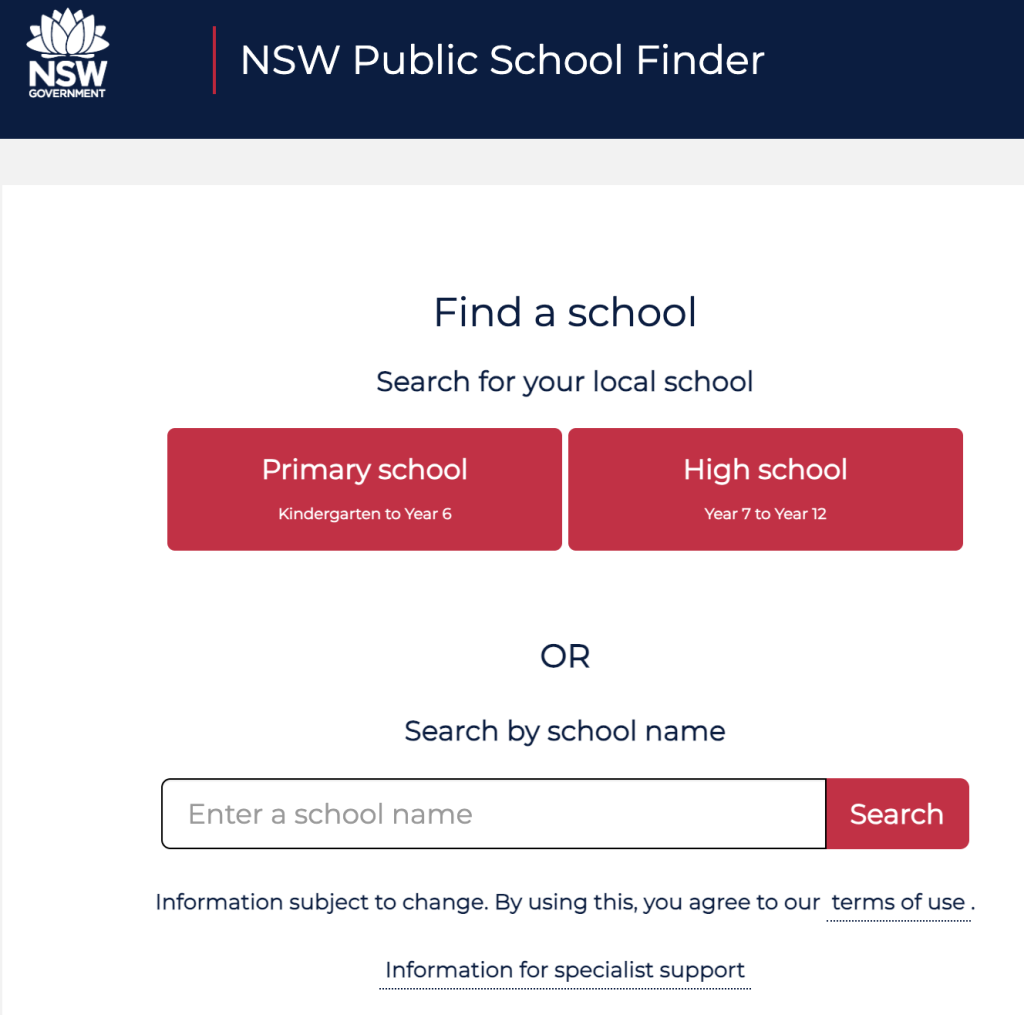
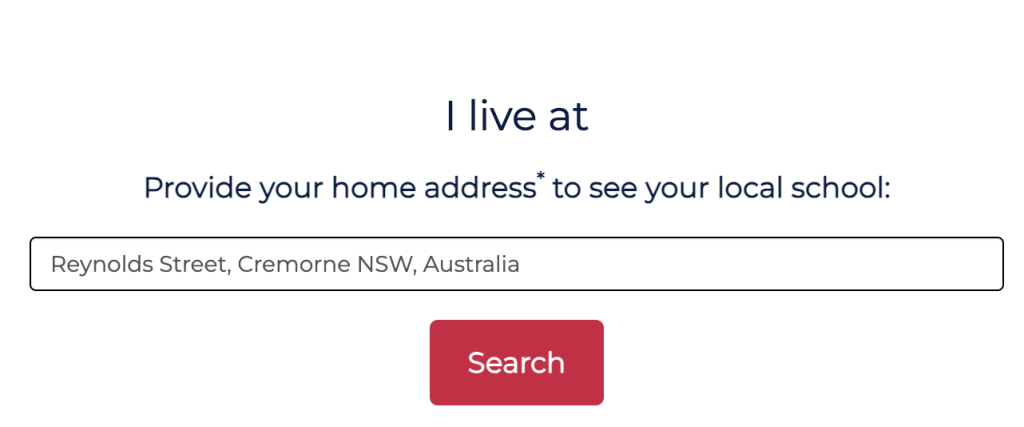
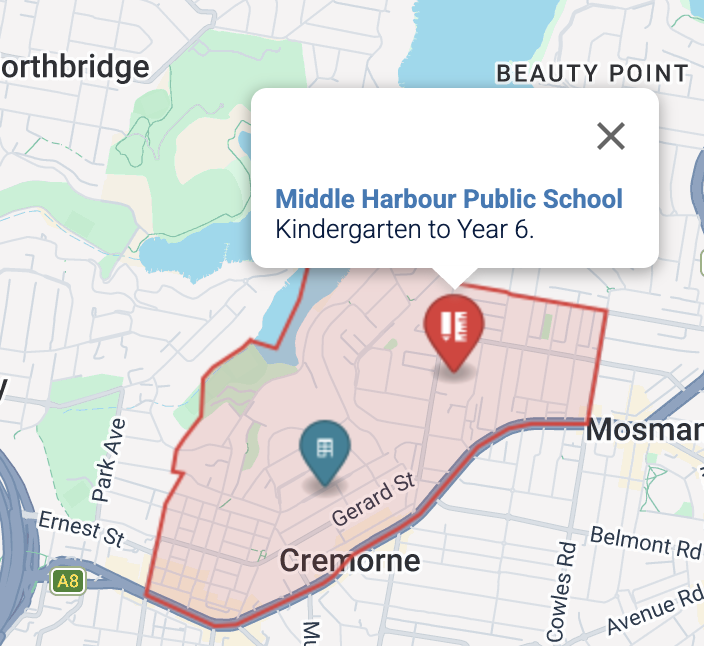
When you search a school catchment zone, the information provided goes well beyond simply confirming whether a property falls within the boundary. It also outlines the distance to the school (including kilometres via road), full contact details such as address, phone, email and website, the school level and year range offered (for example, Kindergarten to Year 6), and current enrolment numbers. You can also access links to NAPLAN results via the My School website, details regarding special learning needs support, outside school hours care providers, preschool availability, and key administrative information such as the school code and NSW enrolment policy. This broader overview allows families to assess not only zoning eligibility, but also the suitability, scale and support services of the school.
Enrolment Procedures
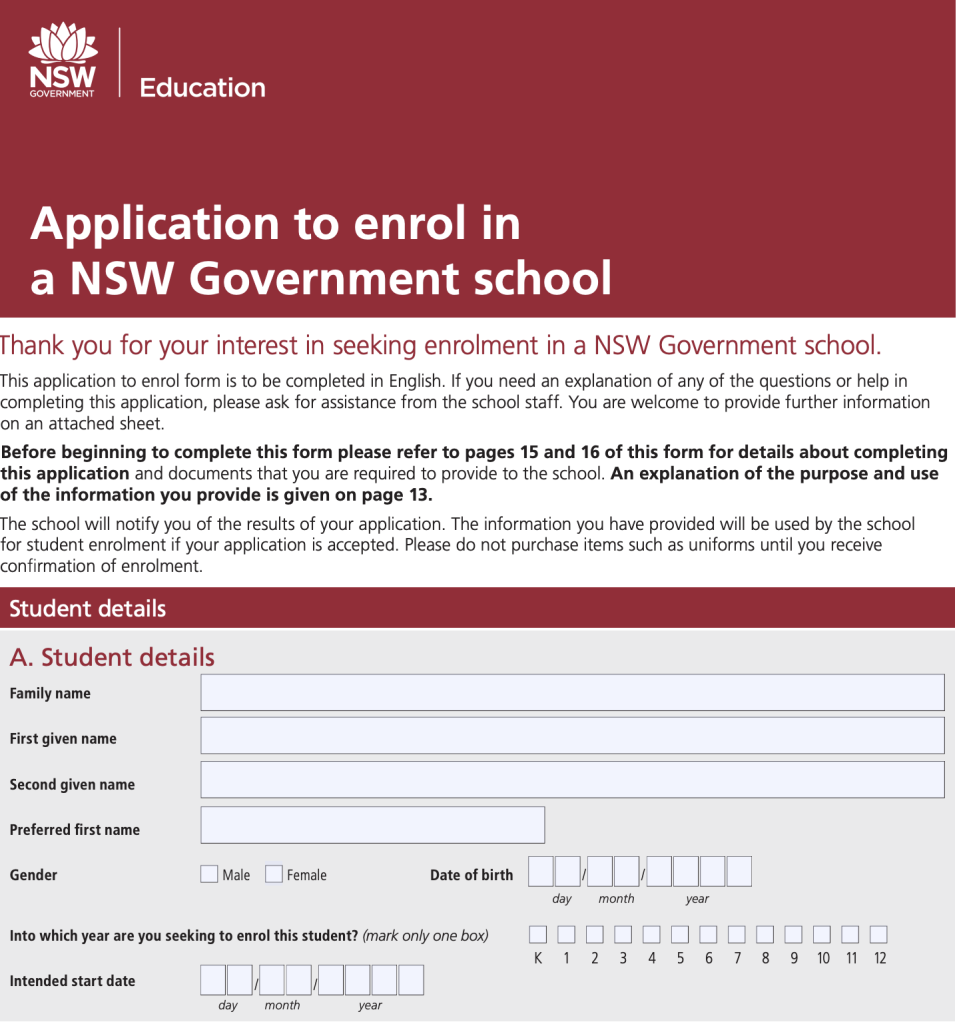
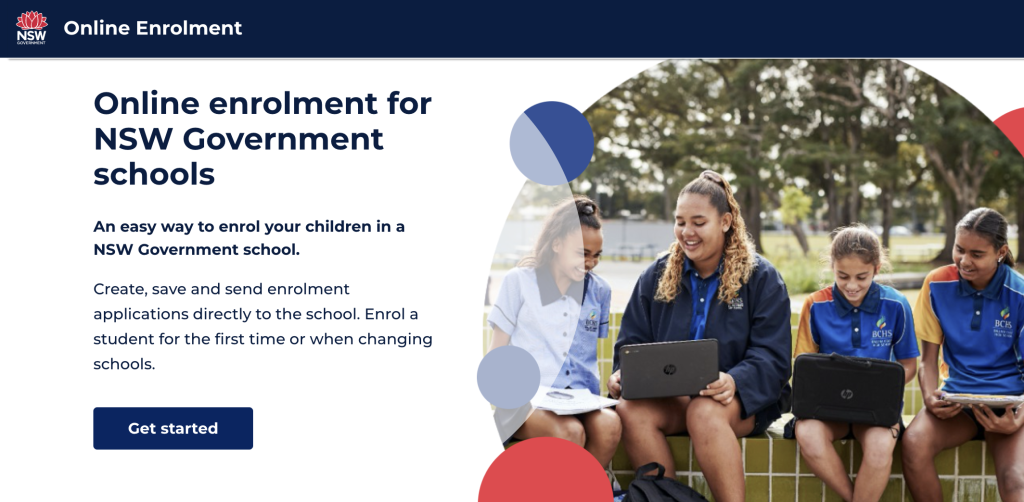
For families enrolling in NSW government schools, local enrolments can be completed either online through the NSW Department of Education’s enrolment system or by manually submitting a paper enrolment form directly to the school. This applies to standard enrolments for students residing within the school’s catchment area. However, certain applications require additional processes and supporting documentation. These include submitting a Moving to High School Expression of Interest, applying to a Selective High School, applying for an Authority to Enrol as a Temporary Resident, and enrolling as an International Student. In these instances, further details and specific application requirements are available via the relevant Department of Education links provided.
Manual Enrolment Form
Online enrolment for NSW Goverment Schools
Opportunity Classes (OC)
An Opportunity Class, commonly known as an OC, is a selective program offered at certain NSW public primary schools for academically gifted students in Years 5 and 6. Places are highly sought after, particularly on the North Shore, and admission is based on a competitive selection test rather than your local school catchment zone — meaning families can apply to any OC school across the state, regardless of where they live.
To be eligible, students must be in Year 3 when applications open and in Year 4 when they close. The test is sat in May each year and is computer-based, covering three sections: reading, mathematical reasoning, and thinking skills. Applications typically open in November and close in February, with placement outcomes released in Term 3. Families can list up to four OC schools in order of preference, and students receive one initial offer based on their test performance and school preferences.
Applications are submitted online through the NSW Department of Education website. The application link becomes active during the application period each year — you can find it, along with full details on key dates, eligibility, and practice tests, at the link below:
education.nsw.gov.au — Selective High Schools and Opportunity Classes
It is worth noting that OC schools on the Lower and Upper North Shore are consistently oversubscribed, and competition for places is strong.
Eastern Suburbs
Primary Schools
| School | Suburb | Gender | OC Class |
|---|---|---|---|
| Bellevue Hill Public School | Bellevue Hill | Co-Ed | No |
| Bondi Beach Public School | North Bondi | Co-Ed | No |
| Bondi Public School | Bondi | Co-Ed | No |
| Bronte Public School | Bronte | Co-Ed | No |
| Chifley Public School | Malabar | Co-Ed | No |
| Clovelly Public School | Clovelly | Co-Ed | No |
| Coogee Public School | Coogee | Co-Ed | No |
| Daceyville Public School | Daceyville | Co-Ed | No |
| Darlinghurst Public School | Darlinghurst | Co-Ed | No |
| Double Bay Public School | Double Bay | Co-Ed | No |
| Glenmore Road Public School | Paddington | Co-Ed | No |
| Kensington Public School | Kensington | Co-Ed | No |
| La Perouse Public School | La Perouse | Co-Ed | No |
| Malabar Public School | Malabar | Co-Ed | No |
| Maroubra Bay Public School | Maroubra | Co-Ed | No |
| Maroubra Junction Public School | Maroubra | Co-Ed | Yes |
| Matraville Public School | Hillsdale | Co-Ed | No |
| Matraville Soldiers’ Settlement Public School | Matraville | Co-Ed | No |
| Paddington Public School | Paddington | Co-Ed | No |
| Rainbow Street Public School | Randwick | Co-Ed | No |
| Randwick Public School | Randwick | Co-Ed | No |
| Rose Bay Public School | Rose Bay | Co-Ed | No |
| South Coogee Public School | South Coogee | Co-Ed | No |
| Vaucluse Public School | Vaucluse | Co-Ed | No |
| Woollahra Public School | Woollahra | Co-Ed | Yes |
High Schools
| School | Suburb | Gender | Selective Status |
|---|---|---|---|
| Matraville Sports High School | Chifley | Co-Ed | Comprehensive |
| Randwick High School | Randwick | Co-Ed | Comprehensive |
| Rose Bay Secondary College | Dover Heights | Co-Ed | Partially Selective |
| South Sydney High School | Maroubra | Co-Ed | Comprehensive |
Selective Schools
| School | Suburb | Gender |
|---|---|---|
| Sydney Boys High School | Moore Park | Boys |
| Sydney Girls High School | Moore Park | Girls |
How Primary School Catchments Shape Property Decisions In Sydney’s Eastern Suburbs
For families with young children buying in Sydney’s Eastern Suburbs, it is often the primary school catchment, not the high school, that most directly shapes where they choose to purchase. The reason is timing: families with preschool or primary-aged children are making property decisions years before high school enrolment becomes a consideration, and securing access to a well-regarded local primary school is an immediate priority.
The Eastern Suburbs are home to several highly sought-after public primary schools, many of which have strong academic reputations, engaged school communities and long-standing appeal with local families. As a result, catchment boundaries can play a significant role in buyer demand and, in some cases, property values.
Some of the most sought-after public primary schools in the Eastern Suburbs include:
• Double Bay Public School
• Woollahra Public School
• Bondi Public School
• Bronte Public School
• Clovelly Public School
• Coogee Public School
• Randwick Public School
• Kensington Public School
These schools consistently attract interest from local families, expatriates returning to Australia and interstate buyers relocating to Sydney. For many purchasers, securing access to a preferred primary school is a key factor in determining which suburb and often which street they choose to buy in.
Properties located within the catchments of highly regarded schools such as Double Bay Public School, Woollahra Public School and Bronte Public School often benefit from strong family demand. While school catchments are rarely the sole reason a property is purchased, they can become an important consideration when buyers are comparing otherwise similar homes across neighbouring suburbs.
For families relocating from interstate or overseas, understanding school catchments is often one of the first discussions we have. The Eastern Suburbs offer an attractive combination of quality public schools, lifestyle amenities, beaches, parklands and proximity to the CBD, making them one of Sydney’s most desirable family destinations.
How Catchment Boundaries Affect Property Prices
School catchment boundaries in Sydney can be remarkably specific, and the difference between being inside or outside a sought-after catchment can influence both buyer competition and resale appeal.
In suburbs such as Bondi, Bronte, Coogee and Double Bay, families frequently narrow their property search to homes located within their preferred school zones. This can create concentrated demand for properties in particular pockets, especially among buyers planning well ahead for their children’s education.
The effect is often most noticeable in family-oriented housing, where school access forms part of a broader lifestyle decision. Buyers are not simply purchasing a home; they are investing in a community, local friendships, convenience and educational continuity for their children.
For interstate and international buyers unfamiliar with Sydney’s education system, school catchments are often overlooked during the early stages of a property search. Understanding these boundaries and how they may influence future demand when it comes time to sell can be an important part of making a well-informed purchasing decision.
A Note On Selective Schools And What They Mean For Property
Unlike local public schools, Sydney’s selective high schools admit students based on academic performance in the NSW Selective High School Placement Test rather than where they live.
Families living in the Eastern Suburbs often consider schools such as Sydney Boys High School and Sydney Girls High School, both of which attract students from across Sydney. Because entry is determined by examination results rather than residential address, buying within a particular catchment does not guarantee access to a selective high school. Families whose long-term education plans include selective schooling should view school catchments and selective school aspirations as separate considerations.
That said, many Eastern Suburbs communities attract education-focused families, creating strong local school cultures and highly engaged parent communities. This ongoing demand contributes to the enduring appeal of suburbs across the region’s property market.
For families where education is a key consideration, working with a buyer’s agent who understands school catchments, local demographics and the factors that drive long-term buyer demand can help ensure a property purchase supports both lifestyle and investment objectives.
Are You A Sydney Property Buyer?
For more information on schools in NSW, including public school catchment maps and everything you need to know about navigating Sydney’s education system, read our comprehensive guide to schools in Sydney.
School catchments and property go hand in hand on the North Shore. If you’d like expert guidance on buying in the right area for your family, we’d love to help — contact us today.